Leonard Bateman: Difference between revisions
| (6 intermediate revisions by the same user not shown) | |||
| Line 1: | Line 1: | ||
==Leonard Arthur (Len) Bateman (1919-2019) PEng, Past President of EGM== | ==Leonard Arthur (Len) Bateman (1919-2019) PEng, Past President of EGM== | ||
This article was originally published in the 100th Anniversary Issue of Keystone Professional in 2020. | This article was originally published in the 100th Anniversary Issue of the Keystone Professional in 2020. | ||
<li style="display: inline-block;">[[File:20Spring.pdf|thumb|none|250px|Keystone Professional Spring 2020]] </li> | <li style="display: inline-block;">[[File:20Spring.pdf|thumb|none|250px|Keystone Professional Spring 2020]] </li> | ||
| Line 31: | Line 32: | ||
</gallery> | </gallery> | ||
= | {| class="wikitable" | ||
I had the good fortune of working under Len Bateman’s direction for most of the 23 years he worked at Manitoba Hydro. This was a hectic period at a time when electrical demand was growing. Len, as part of the Executive, helped make the prudent engineering decision in the 1960s, to develop hydro power on the Nelson River, rather than developing coal-fired generating stations in the south of the province, for which he awarded the Order of Manitoba in 2003. | |- | ||
! Tribute to Len Bateman, a Trailblazing Engineer | |||
|- | |||
| | |||
I had the good fortune of working under Len Bateman’s direction for most of the 23 years he worked at Manitoba Hydro. This was a hectic period at a time when electrical demand was growing. Len, as part of the Executive, helped make the prudent engineering decision in the 1960s, to develop hydro power on the Nelson River, rather than developing coal-fired generating stations in the south of the province, for which he awarded the Order of Manitoba in 2003. | |||
Len was instrumental in pioneering high voltage direct current (HVDC) transmission in Canada, determining that point-to-point transmission, using HVDC, was the most effective way to transport a huge block of power from the Nelson River, some 900kms, to southern Manitoba. | |||
Furthermore, Len recognised that, in building a hydro generating system, there would be considerable periods of time when there would be power surplus to Manitoba’s needs. He decided that the best place to sell this surplus power was to the United States. Public controversy erupted over this plan, nevertheless, Len persevered, and three lines were built by 1985, with the largest interconnection being a 500,000-volt line from Winnipeg to Minneapolis, the highest voltage for Manitoba Hydro at that time. As the US power exports continued, and revenues flowed into Manitoba, the public gradually recognised the benefits of selling power to the States, and criticism faded away. | |||
Len Bateman has left a legacy of competent engineering, which will serve Manitoba Hydro for many years to come. Even the most caustic critic would have to agree it was well engineered. | |||
Due to Len’s contribution to Manitoba Hydro, Manitobans enjoyed the lowest rates on the North American continent for a period of 50 years. There was never a shortage of power, neither did the lights ever go out. | |||
Canadians owe a debt of gratitude to Len for his contribution to the power industry. His engineering works were duly recognised in 2016 by the Government of Canada, which awarded him the Order of Canada. | |||
Will Tishinski, P.Eng (Ret) | |||
Vice-President, Manitoba Hydro (retired) | |||
|} | |||
==Len Bateman's Memoir== | ==Len Bateman's Memoir== | ||
Len published his memoir in July 2004 on the Engineering Institute of Canada website. | |||
Editorial action - need to get the pdf viewer to work. | Editorial action - need to get the pdf viewer to work. | ||
<li style="display: inline-block;">[[File:EIC- ENGINEERING HISTORY PAPER34 An Engineering Career in the Hydro-Electric Industry - Len Bateman Memoirs.pdf|thumb|left|EIC- ENGINEERING HISTORY PAPER34 An Engineering Career in the Hydro-Electric Industry - Len Bateman, July 2004]] </li> | <li style="display: inline-block;">[[File:EIC- ENGINEERING HISTORY PAPER34 An Engineering Career in the Hydro-Electric Industry - Len Bateman Memoirs.pdf|thumb|left|EIC- ENGINEERING HISTORY PAPER34 An Engineering Career in the Hydro-Electric Industry - Len Bateman, July 2004]] </li> | ||
== | ==References== | ||
[[File:1976 - L.A. Bateman.pdf|1000px]] | [[File:1976 - L.A. Bateman.pdf|1000px]] | ||
==Posted by== | |||
Trent Erskine, PEng (FEC) | |||
Latest revision as of 11:36, 18 November 2026
Leonard Arthur (Len) Bateman (1919-2019) PEng, Past President of EGM
This article was originally published in the 100th Anniversary Issue of the Keystone Professional in 2020.

January 14 would have marked Mr. Bateman’s 101st birthday. But, in spite of his passing on December 7, 2019, to have lived a century through periods such as the Great Depression, World War II, and some of the world’s most extraordinary moments in history, is, of itself, remarkable.
Those within the engineering community will, no doubt, remember Mr. Bateman for his contributions to the field of engineering, particularly as they pertained to high voltage direct current electricity transmission, and the pivotal role he played in the development and expansion of Manitoba’s electrical system as a hydro-based system, rather than a thermal-based system. But his illustrious career, which began in 1942 and spanned 70 years, went beyond this province, impacted the progress of developing nations and gave Canada a place on the world stage.
It’s a feat that anyone could look upon admiringly with a sobering awareness that it takes a special kind of drive to keep going, to keep learning, and to keep achieving even when it seems as if you’ve just about done it all. And therein lies the legacy of Mr. Bateman.
Born in Winnipeg on January 14, 1919, Mr. Bateman attended Kelvin High School and went on to further his studies at what was then United College, now the University of Winnipeg. While his goal was to gain enough credits to pursue studies in mining engineering, he eventually switched his focus to electrical engineering, enrolling in the University of Manitoba in 1939. By 1942, he had completed his studies and was in search of the next challenge, which ushered him into the world of electrical engineering at City of Winnipeg Hydro Electric System, commonly known as City Hydro. For many, this achievement would have marked the summit of their careers, but Mr. Bateman was hardly satisfied and went on to successfully pursue a master’s degree as the only student enrolled at that time in the electrical engineering program at the University of Manitoba.
Even with the responsibilities of a full-time career and a young family, Mr. Bateman realised the importance of being present and being involved. He joined the Association of Professional Engineers of Manitoba in 1948, and would go on to serve on the Council, and later become its president in 1958.
His professional career soared, too, with several promotions at Winnipeg Hydro up until his departure from the organization in 1956 for the Manitoba Hydro Electric Board. When the newly created Manitoba Hydro opened its doors in April 1961, Mr. Bateman was among the five new directors chosen to helm the organisation’s operations. By 1972, he was appointed chairman and chief executive officer. He represented Manitoba Hydro on a trade mission to China, and later on another mission to Russia. He also played a key role in securing funds to finance the province’s hydro construction program at meetings across several U.S. cities.
While retirement for many equates to a withdrawal from the world of work, Mr. Bateman saw his, in 1979, as an opportunity to forge a new path. He opened his own consulting firm, offering his expertise both within and outside of Canada. Along with his work as a consulting engineer, Mr. Bateman still managed other professional ambitions, including serving as an adjunct professor at the University of Manitoba, and his appointment as the only Canadian to chair one of the Congrès International des grands reseaux électriques, or CIGRE’s, most prestigious committees.
Mr. Bateman also gave back to the profession in other ways. In 2009, he created a scholarship fund to benefit third-year engineering students, appreciative of the financial difficulties that often arise for them, and that he too had experienced during his third year at the University of Manitoba. The fund has since grown to support two engineering students each year.
Mr. Bateman welcomed challenges and relished the idea of solving new problems. This acuity of mind was not lost on his community of fellow engineers and admirers. In 1994, he was awarded the National Gold Medal by the Canadian Council of Professional Engineers, and now Engineers Canada, for his contributions to the profession. In 2003, the province recognized Mr. Bateman’s achievements with the Order of Manitoba. In 2016, he was awarded the Order of Canada for his efforts in advancing the development and expansion of hydroelectric power in Manitoba. The Association also celebrated Mr. Bateman’s many achievements with the Merit Award in 1976 for his pioneering efforts in the production of power in Manitoba, and Honorary Life Membership in 2000 for meritorious service. He was also awarded the Queen Elizabeth II Golden Jubilee Medal in 2002 and the Queen Elizabeth II Diamond Jubilee Metal in 2012.
One could argue that Mr. Bateman was blessed with a lot of time to achieve as much as he had, but an even more compelling argument would be that he chose to use that time with which he was blessed to benefit so many.
As Engineers Geoscientists Manitoba celebrates its 100th year of engineering regulation in the province, it seems perfectly fitting to remember Mr. Bateman’s legacy as a Trailblazing Manitoba Engineer.
-
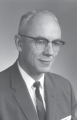
There’s one thing in life that is never guaranteed: time. How we choose to spend the time we do have can make for the most intriguing of life stories and leave an indelible mark on those who are left behind. If there’s one outstanding example of a life well lived and a legacy worthy of acknowledgement, Leonard A. Bateman’s was nothing short of exemplary.
-

Left to Right, Leonard Bateman, Halina Zbigniewicz, and Will Ticshinski
-
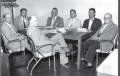
APEM Council 1956. Len Bateman is seated back left.


| Tribute to Len Bateman, a Trailblazing Engineer |
|---|
I had the good fortune of working under Len Bateman’s direction for most of the 23 years he worked at Manitoba Hydro. This was a hectic period at a time when electrical demand was growing. Len, as part of the Executive, helped make the prudent engineering decision in the 1960s, to develop hydro power on the Nelson River, rather than developing coal-fired generating stations in the south of the province, for which he awarded the Order of Manitoba in 2003. Len was instrumental in pioneering high voltage direct current (HVDC) transmission in Canada, determining that point-to-point transmission, using HVDC, was the most effective way to transport a huge block of power from the Nelson River, some 900kms, to southern Manitoba. Furthermore, Len recognised that, in building a hydro generating system, there would be considerable periods of time when there would be power surplus to Manitoba’s needs. He decided that the best place to sell this surplus power was to the United States. Public controversy erupted over this plan, nevertheless, Len persevered, and three lines were built by 1985, with the largest interconnection being a 500,000-volt line from Winnipeg to Minneapolis, the highest voltage for Manitoba Hydro at that time. As the US power exports continued, and revenues flowed into Manitoba, the public gradually recognised the benefits of selling power to the States, and criticism faded away. Len Bateman has left a legacy of competent engineering, which will serve Manitoba Hydro for many years to come. Even the most caustic critic would have to agree it was well engineered. Due to Len’s contribution to Manitoba Hydro, Manitobans enjoyed the lowest rates on the North American continent for a period of 50 years. There was never a shortage of power, neither did the lights ever go out. Canadians owe a debt of gratitude to Len for his contribution to the power industry. His engineering works were duly recognised in 2016 by the Government of Canada, which awarded him the Order of Canada. Will Tishinski, P.Eng (Ret) Vice-President, Manitoba Hydro (retired) |
Len Bateman's Memoir
Len published his memoir in July 2004 on the Engineering Institute of Canada website. Editorial action - need to get the pdf viewer to work.
References

Posted by
Trent Erskine, PEng (FEC)

